Monday, January 3, 2011

Micro Irrigation;
the way to 2nd Green Revolution

There were times when people used to begin their speech/ lecture saying “Indian agriculture is a gamble with monsoon.” The scene has changed now. Thanks to micro irrigation and an increasing number of fields and crops getting covered with it, we can begin our speech with talking about improved yield, better quality produce, and higher monetary returns with efficient utilization of inputs.

Indian agriculture is basically rainfed farming, as most of our farmlands do not have enough irrigation facilities throughout the cropping season. This makes it imperative to use the available resource efficiently, sustainably, and economically to get the best yield out of that.

Water, one of the most necessary production input, is getting scarce, particularly in the aftermath of untoward events of climate shift, fast groundwater depletion, and repetitive monsoon failures. The shift from conventional flood irrigation to sprinkler, micro sprinkler, or drip irrigation systems is apparently visible, indicating the importance of water use efficiency for covering more area under irrigation.

The Government support in the form of subsidy is serving as a catalyst to compensate for the high initial cost of the system. Irrigation through micro irrigation techniques can give a real spurt in the water use efficiency as compared to the conventional means wherein we stand to loose copious amounts of water through evaporation, leaching, seepage, and percolation. Micro irrigation systems (MIS) direct droplets of water carefully, so much so that water use efficiency is enhanced to the tune of 30% - 60%. The advantages of this system has also prompted many farmers to adopt a more intensive way of cultivation incorporating multiple crops and a better cropping pattern, thus, increasing the yield and income from unit area to a greater extent.

Micro irrigation technology is gradually emerging as demand driven technology in India. This stage has come about over a period of 20 years. The role of Private manufacturers, government policies, and level of farmer awareness and that of media has helped to create the present situation - from a scantily respected “forced in Technology” micro irrigation to “much sought after” technology.

The coverage of micro irrigation is 5 million ha in India, which is far behind the potential area estimated at around 116 mha. The awareness level, however, has grown tremendously. yet, the spread of technology is restricted to states like Maharashtra, Andhra Pradesh, Gujarat, Tamil Nadu, Karnataka, Madhya Pradesh, and Rajasthan. The Northern states of India still have not come into the main picture yet. States like Haryana and UP are slowly getting into the groove.

There is an overall potential of more than 30 million ha area in India for providing drip irrigation. This includes fruits, vegetables, Sugarcane, Cotton, Tobacco, spices, Tea, Coffee, Rubber, Coconut, and floriculture crops. Of the potential area for Drip irrigation, only 58% comes under irrigation cover at present. The idea of rain water harvesting and farm pond concept would have to be taken with high priority to bring in the presently rain fed areas under drip irrigation. Similarly, 40 million ha area grows crops that can be suitably irrigated by Sprinkler systems.

There are manifold benefits of adopting the micro irrigation technique, which includes water saving to the extent of 40-60%, upto 40% yield benefits, healthy crops, fertilizers saving, labour cost cutting, bringing the problematic area under profitable cultivation, improving the overall quality of the produce, etc.

Using micro irrigation system, water is applied to the plant root zones as per the crop water requirements. This enables the plants to yield at the best of their capacity, in the lack of moisture crises at any stages of the crop growth. The soil moisture level is always maintained at the field capacity. Due to these and many more reasons, the technology is getting popular among the farming community.

Policy Interventions

Earlier, the impact of the invaluable technology was to the laudable scale and sector was much apprehensive about its growth, but government subsidies and financial assistance did the miracle job and today, even small / marginal farmers are installing the system on their farm for reaping the benefits of the well documented success stories at pan India level. National Horticulture Mission (NHM) acted as catalyst for the systems and the launch of National Mission on Micro Irrigation (NMMI) in June 2010 had a considerable total outlay of Rs 1000 crores, which was much ahead of the earlier allocation of Rs 450 crore to the Micro-irrigation scheme. With this, the Micro-irrigation scheme is going to be extended to a total of 18 states from 12 states at present.

Agriculture ministry has recently released the new guidelines on National Mission on Micro Irrigation (NMMI). In this, the government has increased subsidies provided under the National Mission on Micro Irrigation (NMMI). Under the new NMMI guidelines, small and marginal farmers will get a subsidy of up to 60% of the MI project cost from the Union government, compared to a subsidy of 50% earlier. Other farmers will get a subsidy of 50%, compared to 40% earlier, for land holdings with a maximum area of 5 ha. The guideline also includes new MI technologies such as fertigation systems, sand filters, etc. Besides, payments are likely to get accelerated as the subsidy will now be disbursed by state implementing agencies, instead of district authorities. The agriculture ministry has allocated 1,106 crore for the NMMI scheme for the current year.

With these, the Mission would boost converge of micro irrigation activities under major government programmes such as National Food Security Mission (NFSM), Integrated Scheme of Oilseeds, Pulses, Oil palm & Maize (ISOPOM), Technology Mission on Cotton (TMC), etc. for increasing water use efficiency, crop productivity, and farmers income.

Industry.....on the move

Today, the industry is vibrant like any other agri input sector, with the presence of all major Multinationals and desi giants and world class technology to farmers in India, helping them in optimum utilization of scarce water resources, enhancing farm productivity and quality of their produce.

Some of the major players in micro irrigation in India are Jain Irrigation, Netafim, Plastro Plasson, Nagarjuna, Parixit, and Premier. Apart from this, John Deere has also ventured into the Indian segment last year. Many other small and medium micro irrigation companies are functioning, mainly from Pune and Bangalore, which is making the industry highly competitive. The international expertise and desi blend of technology are working tirelessly in cost minimization and bringing refinement in the presently available systems.

Fertigation and Soluble/ Liquid fertilisers

Looking into the prospects of drip covering more and more area, another parallel industry of soluble fertilizers is catching the momentum.

Fertigation allows an accurate and uniform application of nutrients to the wetted area, where the active roots are concentrated. Therefore, it is possible to adequate the nutrients quantity and concentration to their demand through the growing season of the crop. Consequently, recommendations have been developed for the most suitable fertilizer formulation, including the basic nutrients NPK and micro nutrients according to the type of soil, physiological stage, climate, and other factors.

Fertigation system and nutrient supply to the crops according to their physiological stage of development, and consideration of the soil and climate characteristics, result in high yields and better quality crops with minimum pollution, thus, ensuring manifold benefits from the technology.

Almost all major private fertiliser companies supply liquid fertilizer in one or another form and micro nutrients. But majority of the liquid fertilizer is still imported from countries, mainly Israel and Netherland, whereas the Indian companies are mainly involved in their marketing and distribution.

As on today, the cost of liquid fertilizer is too high and unaffordable by most of the drip farmers, so government has to give an economic consideration for its wider adoptability.

Newer avenues

Micro irrigation technique should be furthered to other field crops in view of its resource utilization efficiency and economic benefits accrued per unit investment. Jain irrigation, ICRISAT, and some other government and private institutions are working on standardizing the protocol of micro irrigation for water intensive crops like rice and sugarcane, which can pave the way for much talked future of green agriculture.

Over the period, much collaboration had come up between public and private sector to refine the technology. In this direction, ICAR and many of the private companies have collaborated with Israel based institutions and multinational in the sector. Israel and Netherland are the countries, which have the authority on the sector and their productivity is on the same line.

There is a need for developing seeds and varieties suitable for cultivation under the micro irrigation system, so that more resource efficiency can be ensured, with aptly exploiting the production potential of the crop.

Netafim’s Jugaad technology

The world’s largest micro-irrigation company indigenised its Family Drip System (FPS) for mainstream farming in India. As a result, drip irrigation is now available for farms that are as small as a quarter acre. FPS was originally developed for irrigating the backyard gardens in developed countries.

For the purposes of drip irrigation, India’s farm needs were different from most other countries in two significant ways - small fragmented land holdings and electricity availability at the farms.

The conventional FPS is a pressure compensated system, which ensures that the flow of water is equal all over the farm right from the beginning to the end of the pipes, both on low lying portions of the field and on higher levels. This is achieved through valves, which clamp down when the water pressure increases and eases up when this pressure decreases. A conventional FPS has tap inlet through which the water supply is taken into the system.

This is where Netafim used a little bit of Indian jugaad/ improvisation, as water supply is not very regular on Indian farms.

To create water pressure, Netafim decided to befriend gravity. It recommended the setting up of a water tank at a height. This water tank could be filled with water with just 10 minutes of electrical motor power. If there was no electricity, the water could be filled in the tank through a hand pump. Once the tank was full, it could irrigate the field for over three hours.

As against other systems that would cost at least double, this system cost just Rs. 30,000 of which 50 percent came in by way of a grant from the state government. The farmer had to finance just around Rs. 15,000.

Way to ‘GO’

Other than the present level of subsidy by GOI under NMMI, additional assistance should be entrusted to the farmers of the water deficient regions and dryland areas, so that the majority of the areas could be brought under the cultivation.

But still the cost factor is hindering its growth story to make inroads into the areas of low risk bearing farmers and with the ongoing sets of R&D in the sector, to make it more affordable and befitting for such farmers. The days are not far when the diesel and electric irrigation pumps would go redundant and India would boast of the second Green Revolution, which can only be ensured through the way of efficient resource utilisation.

The uncalled for story of Endosulfan ban

India, the largest producer, exporter and consumer of Endosulfan has opposed the global ban of the ill-fated chemical, after much dramatised events of anti-pesticide lobby groups documented and presented many cooked data and stories of health and environmental impacts of the same, mainly in the cashew plantations of Kasargod district of Kerala in the view of its rampant use.

Since long time, Endosulfan is being blamed/ targeted for causing persistence soil pollution, adverse effects on human health, in form of many of the dysfunctions and deformities and other adverse impacts on ecology.

In view of the same, Government constitutes many of the review / enquiry/ fact finding committees but none found any of the objectionable ill effects of endosulfan either on human beings/ ecology as claimed by the not-so-profit groups of pesticide activists.

Several studies conducted by Kerala Sasthra Sahitya Parishad, Achuthan Commission, Kerala Agriculture University, IMA, Dubey Committee have concluded of no linkage between use of Endosulfan and the reports of health problems to the use of Endosulfan on the health problems reported at the Kasargod district of Kerala. All these studies have been conducted as recently as in the last eight years. Al claims have found and proved to be ‘hyped’ by the agencies to get funding for from the sides, gaining profit out of the ban imposition.

Kerala had stopped use of Endosulfan in 2005 and it is strange that the harmful effects were brought to light only recently. Endosulfan was sprayed across 10000 acres of Cashew crops throughout Kerala, prior to the ban - had Endosulfan been the cause of physical problems inside Kasargod, the Kerala state should have witnessed similar cases elsewhere as well.

India consumes around 12 million litres annually, of which more than a third is by Andhra Pradesh, Maharashtra and West Bengal. When no such harmful effects have been reported from these and other major consuming States, how can endosulfan cause problems in Kerala, which, even at its peak, was consuming a few kilolitres.

It is high time to seek an independent investigation into the flaws observed in the study which was released by the National Institute of Occupational Health (NIOH). The NIOH study was adopted by NGOs for propaganda against the generic pesticide Endosulfan since year 2002. Based on unscientific approach, the demands made by local NGOs should not be taken into account for considering such a serious decision affecting our country’s agriculture and food security system.

Major facts about Endosulfan:

  • India is the world’s No. 1 producer, exporter and consumer of endosulfan
  • India supplies 28 million litres (70%) of the total global endosulfan market of 40 million litres
  • The 28 million litres include 12 million litres for domestic market (worth Rs 270 crores) and 16 million litres of exports (worth Rs 180 crores)
  • Major Endosulfan manufacturers include Excel Crop Care, Coromandal International and Hindustan Insecticides Ltd.

Domestic pesticide manufacturers and Industry body, Pesticides Manufacturers and Formulators Association of India (PMFAI) accuses Multinational firms of their vested interests driving the demand for banning Endosulfan pesticide in India, as the MNCs are interested in promoting their patented products in the country. As the much sought for International ban would create a market for their products in the third world countries.

Endosulfan is being used in the country for the last 50 years and there has been no such scientific records available, which indicate that the use of this chemical has resulted into serious health hazards of any kind, stated International Stewardship Centre, an NGO working for chemical industry, and of the pragmatic view that replacing Endosulfan with any other chemical would be at least 10 times costlier for the Indian farmers. As a litre of Endosulfan costs Rs 250 to Indian farmers whereas any chemical manufactured by multinational would cost more than Rs 2,500 per litre thus making the use of pesticides 10 times costlier and unaffordable to the majority of small and marginal Indian farmers. Moreover, it is soft on pollinators such as honey bees, while being beneficial for lady bird beetle, chrysoperla, trichograma and other friendly insects.

The Indian pesticide industry has opposed listing of endosulfan as a ‘Persistent Organic Pollutant' (POP) under the Stockholm Convention, suggesting that the proposal is inspired by European agrochemical interests.

Endosulfan has been manufactured and exported out of Europe for over 55 years. There were no issues over its use until 2001, when the sole European manufacturer (Bayer CropScience) also decided to phase out the product from its portfolio. Following the particular manufacturer's move, the European Union (EU), in 2005, withdrew all authorisations for use of plant protection products containing endosulfan. Two years later, the same multinational stopped manufacturing endosulfan, even while continuing with its sales. The same year, the EU sought listing of endosulfan as a POP before the Stockholm Convention.

All these actions may be coincidental. But there are, no doubt, strong business interests which wouldn't mind if farmers are forced to replace endosulfan, which is an affordable and generic insecticide, with costlier proprietary molecules. It is purely about patented-versus-generic pesticides.

Endosulfan is the world's third largest-selling generic insecticide, with a 40-million litre-plus market valued at over $300 million. Currently, the Indian market of Endosulfan is about 12 million litres annually valued at Rs 270 crore. In India, there are three manufacturers of Endosulfan, including Hindustan Insecticides Ltd. At present, the overall Indian agrochemical market stands at Rs 5,200 crore and Endosulfan Rs 300 crore.

The Stockholm Convention, to which India is a signatory, requires parties to eliminate or reduce the release of POPs into the environment. While a POP Review Committee of the Convention, in October, agreed on categorising endosulfan as a POP, a final decision would, however, be in the hands of a Conference of Parties in April 2011.

In the meantime, some 60 countries, including the 27 EU members States and 21 in Africa, have favoured banning the agrochemical. These countries account for hardly 12 per cent of the total global endosulfan consumption. Some of them, especially in Africa, have no choice, as they export cocoa and other farm products to the EU. On the other hand, India, China and Argentina have come out strongly against the proposed ban.

There are over 6000 workers employed in the manufacturing of Endosulfan in various plants of India and 400 of these workers are employed in the HIL plant. But no adverse health effects have been reported of the thousands worker and where the areas where its use is banned talks of all kind of malfunctioning and ill effects.

At present India has banned 27 pesticides for manufacture, import and use. However, in the study done by Consumer Voice, of the five banned pesticides that foodstuffs were tested for, four were found to be present in various fruits and vegetables.

The authorities need to improve Maximum Reside Limit(MRL) standards, which is at much higher sides when compared with the values of European/ American countries or, and put some specific pesticides on the list of banned pesticides. But it can be well argued that India still uses far less pesticides than many other countries. The real problem is that many farmers do not know the right time to spray pesticides, nor the right amount that needs to be sprayed. So proper education&training of growers about the safe pesticide practices with strengthening the extension system will only make the difference for all stakeholders of the sector.

Indian regulatory agency has clear conscience about the whole thing and clarified its stand of not favouring the move to ban the pesticide in lack of any strong evidence and review done by several committees, declaring Endosulfan as safe for both human beings and ecology.

Friday, December 17, 2010

India urgently needs a new Green Revolution

Agriculture has an importance in India out of all proportion to its 15 percent contribution to Gross Domestic Product, which nevertheless absorbs at least 40 percent of the workforce (not to mention the centuries of rural tradition lying behind it). Everybody talks about the role of globalization and software in opening up the Indian economy in the last two decades but would economic takeoff have been possible without the Green Revolution?

But the Green Revolution has since run out of steam with India losing its self-sufficiency in food (apart from rice and wheat) since 2005 (India was a net food exporter until then). If nearly half the population is needed for less than a fifth of output, a second Green Revolution to snap India out of primitive subsistence agriculture would seem to be urgent. Or is it — might it not be that India deliberately tolerates the inefficiencies of an overmanned agriculture in order to keep them down on the farm as a lesser evil to swamping already overcrowded cities?

Last month the Herald put these questions to the Agriculture Ministry’s Mukesh Khullar in his office in Krishi Bhavan (the Ministry building) in the heart of New Delhi.

Khullar did not hesitate in replying that a new Green Revolution cannot be postponed despite any possible social disruption — with food security a global issue, India owed it to both itself and the world to realize its full economic potential and dramatically raise productivity. Everything else was simply growing too fast — the economy, the population (which could reach 1.5 billion people within the next generation) and demand for more and better food from that population. Even a totally successful second Green Revolution could not avert the need to increase food imports from countries like Argentina because of the explosive growth of demand at every level. In particular, an agriculture based on a vegetarian culture is not used to producing proteins and here Argentina could come in very handy (this year’s intensified imports of soy oil from here has been joined by an incipient interest in lentils).

Yet even without a new Green Revolution or economies of scale, Indian agriculture is not to be despised. Its total grain harvest of 260 million tons almost trebles Argentina’s on only around 25 percent more land while its cattle population of 282 million head vastly outnumbers ours (not in quality though) — India is the world’s third-largest producer of agricultural commodities (number one in rice, tea and milk). This does not necessarily establish Indian agriculture as more efficient but rather goes to show that with ample sun and monsoon rain, India is naturally far more fertile than even the fabled pampas — apart from the structural bottlenecks, the main barrier to India being the world’s food basket is that it already houses a sixth of the world. India and Argentina are very different in agricultural as well as other aspects but the two countries could learn much from each other, says the Foreign Ministry’s Dammu Ravi (Joint Secretary Latam & Caribbean Division).

Even without maximizing agricultural potential with a new Green Revolution, only two percent of the food being produced now is processed and that is the key to improving efficiency while keeping them down on the farm in Kullar’s view — bring in food-processing companies (whether multinationals or local agri-businesses) to produce at source, offering them free land and tax holidays in areas of high rural unemployment with the short-term aim of creating 10 million jobs.

Some experts think that the potential for food processing is so huge that agriculture could return to being a third of the economy despite such rapid growth in the two other sectors (especially services) — agri-business has clocked 20 percent growth per annum in recent years and there are hopes of trebling its volume by 2015. Even riddled with poverty, inefficiency and substandard yields, Indian agriculture could still be a vibrant player in globalization. Because of the immense cultural and political importance of the rural world, agri-business is a priority for the government and perhaps more deregulation work awaits here than in the rest of the economy.

Khullar does not only look to food-processing industries and agri-business to integrate rural communities into a globalized world — various services could be extended to villages with investment in education, human resources and new skills. There is an enthusiasm for introducing professional management into farming like the rest of the economy, turning farmers into shareholders — this actually seems to appeal more to the peasant mentality than co-operatives. Khullar feels that the ancient traditions can be overcome far more rapidly with modern communications — television and telephones make a huge difference. The new communications technology will also make it easier to educate people in villages, instead of forcing them to urbanize.

Credit and infrastructure are also crucial — India has already been successful in providing electricity generation and Indian ingenuity is starting to come up with new ways of making agriculture more water-efficient, such as micro-irrigation and techniques of harvesting rice without the traditional flooding. All these policies need to be implemented in not only an intelligent but also region-specific way with regard to the available technologies.

Yet in these days of worldwide concern about climate change, India cannot simply let rip with agricultural development — some very strange things have been happening in Indian weather recently such as droughts in lushly green Bihar and Assam and downpours in arid Rajasthan. Thus the concept of sustainable agriculture was at the heart of the Biennial Agro Technology & Business Fair held last week in Chandigarh, ensuring that agro-chemicals and fertilizers are placed under ecological stewardship.

The net result of all these changes would not be to shrink rural population or overcrowd the cities but to reduce pure farmers to around 10 percent of the population with the rest in related activities — those with skills would continue to migrate but there should be no need to force anybody to leave. This transformation would require 20-25 years in Khullar’s opinion.

Is it possible for an economic transformation which owes so much to the private sector to modernize agriculture without affecting property rights, the Herald asked? This was a tricky question, Khullar agreed — this involved not only questioning the efficiency of smallholder production but also the quantity of land left idle by rich landlords in states like Bihar. But one thing is clear in Khullar’s mind — change is both urgent and possible but he draws the line at modernization at the cost of social disruption.

Perhaps agriculture is as good an example as any of India’s knack for turning its problems into opportunities.

Horticulture : A Key to All Round Growth of Agriculture

Horticulture is perhaps the most profitable venture of all farming activities as it provides ample employment opportunities and scope to raise the income of the farming community. It also has tremendous potential to push the overall agriculture growth to more than the targetted 4 per cent.

The climatic conditions prevailing in our country are favourable for a large number of horticulture crops such as fruits, vegetables, roots and tuber crops, ornamental, medicinal and aromatic plants. Production of horticultural crops has witnessed a significant improvement over the years, of the 11 per cent of the total cropped area, horticulture accounts for about 28 per cent of agriculture GDP in India.

India ranks second in the global production of fruits and vegetables next to China. It’s share in the World fruit and vegetable production is about 9.2 per cent and 9.24 per cent respectively. India is the largest producer of mango, banana, sapota and acid lime and has the highest productivity of grapes per unit area in the World. Despite this, India’s share in fruits and vegetables trade in the World is very low.

The Government has taken many initiatives to boost horticulture sector in the country. These include National Horticulture Mission (NHM), National Horticulture Board, Technology Mission for Integrated Development of Horticulture in North-East and Himalayan States and financial assistance to private sector and Government agencies to set up post-harvest infrastructure such as warehouses and cold storages etc.

At present, 371 districts in 18 States and 3 Union Territories are covered under the National Horticulture Mission. Apart from States and Union Territories, 13 National Level Agencies have been included for providing support to the developmental efforts which require inputs at the national level.

The total approved outlay for the National Horticulture Mission for the 11th Plan is Rs. 8809 crore. Out of this, an amount of Rs. 3200 crore has been spent during first 3 years of the Plan. NHM is a centrally sponsored scheme in which the Centre’s contribution is 85 per cent and the remaining 15 per cent is met by State Governments. Production of planting material, vegetable seed, seed infrastructure in public and private sector, establishment of new gardens in farmers’ land, rejuvenation/replacement of senile plantation, technology dissemination through front line demonstrations, post-harvest management etc., are covered under the scheme.

From 2010-11 the National Horticulture Mission guidelines have been revised to accommodate new interventions such as High Density Plantations, mushroom cultivation, horticulture mechanisation, and certification of good agricultural practices. Cost norms of some of the activities like setting up of nurseries, area expansion and protected cultivation have been enhanced to provide better incentives to the farmers adopting improved technologies. The cost norms and assistance for post-harvest management have been enhanced and new components introduced to encourage private sector participation in creating NHM infrastructure.

States have also been advised to ensure holistic development of horticulture sector by convergence of schemes implemented by other Government Departments. At the national level, efforts are being made to ensure convergence by dovetailing the resources of the concerned Departments viz. ICAR for research, Ministry of Food Processing Industries for coordinated development of Agri Export Zone (AEZ) for horticultural crops and Department of Rural Development with Mahatma Gandhi National Rural Employment Guarantee scheme and also for providing road connectivity to the crop clusters in the NHM districts. At the level of the Ministry of Agriculture, convergence is ensured with the scheme on micro-irrigation, Rashtriya Krishi Vikas Yojna (RKVY) and Watershed Development Programmes.

During 2005-09, 2192 new nurseries have been set up. Additional area of about 16.57 lakh hectares was brought under new gardens of various horticultural crops. 2.78 lakh hectare of old and senile orchards was rejuvenated to enhance productivity. An area of 1.37 lakh hectare was covered under organic farming. Integrated Nutrient Management (INM) and Integrated Pest Management (IPM) were adopted in 7.48 lakh hectare apart from setting up of 66 disease forecasting units, 78 bio-control laboratories, 98 plant health clinics and 67 leaf/tissue analysis laboratories.

Funds have been provided for setting up of 1093 pack houses, 285 cold storage units, 14 refrigerated vans and 264 mobile/primary processing units, under post harvest management. Nine wholesale markets and 163 rural markets have been set up to ensure proper handling and marketing of agricultural produce. Apart from this, 7.74 lakh farmers have been trained under various horticultural activities.

As per mid-term evaluation study conducted by the National Productivity Council during 2007-08, area under horticultural crops increased by 12.4 per cent. According to the study, availability of planting material has also improved substantially in almost all the States. In addition, 190 million man days employment opportunities have been generated and organic farming has been gaining popularity.

Under the new component of Terminal Market Complex (TMC), which envisages a hub and spoke model for the development of markets under PPP, one TMC has been approved for Patna in Bihar during the current financial year with NHM subsidy of Rs. 33 crore. Three such TMCs have also been approved in Maharashtra, Orissa and Tamil Nadu.

The projected production of horticultural crops during 2009-10 has gone up to 226.87 million tonnes. It includes 73.53 million tonne of fruits and 136.19 million tonne of vegetables from an area of about 21 million hectares. The growth rate in horticulture production between 2004-05 and 2008-09 has been to the tune of 7.2 per cent.

Cultivation of horticultural crops is now increasingly becoming an option to improve livelihood security, enhance employment generation, to attain food and nutritional security, and increase income through value addition. Cost of horticulture products being less than half of those in other parts of the World due to relatively cheap and skilled manpower, Indian farmers are in an advantageous position to exploit the untapped potential.

Thursday, December 9, 2010

US promises not so (ever) green revolution

Mr Obama’s stupendous Indian visit during Diwali had caught the limelight of the whole world for almost a month. But here, the issue is: what does US President Barack Obama's visit connote for agriculture in India? US President expressed that US and India can accelerate cooperation in agriculture and it is the US to learn lessons from India in irrigation systems and low-cost farm machinery. He also interacted through video conferencing with a group of farmers and villagers of Kanpura village of Ajmer in Rajasthan, at the agriculture and food security expo organized by CII. Mr Obama appreciated ICAR, the apex public organization looking after the affairs of agriculture in the country and its work for the farming community.

The Obama regime has maintained continuity with the preceding Bush regime in the basic thrust of USA’s relations with India in agriculture. And keeping this in mind well in advance of the Obama visit, a meeting of the “U.S.-India Agriculture Dialogue Steering Committee” took place in New Delhi with high level experts from both the sides. The Committee reportedly met to identify areas of cooperation for working groups on “Strategic Cooperation” in agriculture and food security; food processing; farm-to-market linkages and agricultural extension; and crop and weather forecasting. The present set of negotiations are only aimed at operationalising the India-US MOU for Cooperation in Agriculture and Food Security, which was signed shrouded in the veil of secrecy well in advance of the Obama visit.

It is only to take forward the vision that brought into existence the India-US Knowledge Initiatives in Agriculture (KIA). But have such initiatives ever led to anything worthwhile? We have already witnessed the debacle of KIA, which had come to an end on 31 March 2010, and all set to get a three-year extension as the Agriculture Ministry had taken up the issue with the US authorities after the five-year-old initiative ended in March. This is despite the Parliament Standing Committee on Agriculture asking the Agriculture Ministry to review the implementation and achievements of the initiative. Very little came out of that agreement and President Obama is likely to re-energise the Indo-US Knowledge Initiative in Agriculture. Since the agreement is facing un-surmountable hurdles because of the inability of the Indian Council for Agricultural Research (ICAR) to pay for staff travels and technologies being imported, it is likely that the U.S. would push through more collaboration in agricultural scientific research through the US-India Strategic Dialogue.

The joint statement from the Prime Minister Manmohan Singh and the Us President Obama suggests that the agenda is far-reaching and open-ended. The collaboration will, it is claimed,

(i) develop, test, and replicate transformative technologies to extend food security as part of an Evergreen Revolution,

(ii) be in the areas of weather and crop forecasting system, improvement in the food processing and crop productivity, and optimum uses of natural resources like water and

(iii) enhance the agricultural value chain and strengthen market institutions to reduce post-harvest crop losses.

While collaboration in farm research will pave the way for the entry of US agribusiness multinationals, especially companies like Monsanto and Du Pont, the thrust of the US talks is going to be an opening of the food retail and insurance sector. A few weeks back, President Obama had expressed hope that India would allow FDI in big retail. Agriculture Minister, Sharad Pawar, too, has been pushing for FDI in a big way and Ministry for Commerce had even set up a small committee to prepare the ground for its entry.

But if the supermarkets were so efficient and provided dynamism, then why is the US providing a massive subsidy for agriculture? After all, the world’s biggest retail giant Wal-Mart is based in America and it should have helped American farmers to become economically viable. But it did not happen. American farmers have instead been bailed out by the government, providing a subsidy of Rs. 12.50 lakh crore between 1995 and 2009, and this includes direct income support. India is, therefore, importing a failed economic model, which would only help the economic recovery of America, and not serve any cause of the beleaguered Indian farmers and the agricultural situation.

Food Management in India

Alien models won't work

- Neehar Ranjan Pandey

In a recently released paper titled "The Economics of Foodgrain Management in India" the chief economic adviser in ministry of finance, Prof Kaushik Basu, has made certain interesting observations. He has been particularly harsh, and rightly so, on the procurement and delivery aspect of the government's foodgrain policy.

It has been pointed out that during the past one year or so, in spite of our food stock continuing to be massive, food prices have been high, meaning thereby that our foodgrain procurement and distribution policy is flawed and has failed to serve farmers and consumers both.

Over dependence on agriculture

Prof Basu underscores the fact that 15% of the notional income comes from agriculture, while close to 60% of India's labour force lives off agriculture, to claim that we have created special incentives which hold back large segments of the population in agriculture, instead of allowing them to move out to industry and manufacturing. However, this line of reasoning is an over-simplification. People in rural areas are stuck in the agriculture sector, not because the government has provided them with spectacular incentives, but simply for lack of any worthwhile options to do something else. There is little opportunity in villages and small towns due to almost non-existent industrialisation. Given the fact that our cities are also teeming with migrant population, the best possible way to reduce excess dependence of the population on agriculture is to somehow explore possibilities of creating sufficient opportunities in rural and semi-urban areas.

Possibilities of establishing new industries in small towns and villages can only be brightened up, if we are able to provide proper infrastructure, including enough power, to sustain industrial activity. Towards this end, the recently launched National Solar Mission could turn out to be a game changer, provided the proposed 5MW solar power projects are evenly distributed across the country. In this context, in the larger interest of the country, we must shed our preference for a tariff-discount-based regime while sanctioning these projects, and instead, strive to cover the entire rural landscape to provide power all across the country.

Release of foodgrain to poor

While criticism of the government's existing policy to hold and release foodgrain is understandable to an extent, it seems that the true import of the recent popular demand (subsequently endorsed by the Supreme Court) to release the grain, rather than letting it rot, to the poor has not been appreciated. The apprehension that the demand might have an important design aspect to it, a part of this food might be resold to the government through the procurement window at a profit, is largely misplaced. No one is asking the government to supply foodgrain to whosoever comes to collect it. Instead, the demand is to distribute foodgrain to the poorest of poor, even at a nominal cost, which otherwise is rotting in godowns.

Prof Basu is right when he lists "maintenance of buffer to hold down prices during food shortages" and "making sure that the poor and vulnerable have access to food at all times" as the two features of his ideal foodgrain policy. However, if it is so, how can the government of a welfare state be a silent spectator when the poor do not get enough food at affordable rates, while FCI storage facilities are overflowing? Further, it must be kept in mind that the two stated objectives are exclusive to each other: release to hold down prices and feeding the poor must be seen and tackled as two different problems, requiring separate solutions.

It is a fact that while we have steadily procured foodgrain, releasing it when the need arises has left a lot to be desired. Prof Basu recommends buying more when prices are low and selling more when prices are high. While the point is well taken, we have also to remember that the government fixes an MSP not only for the purposes of buying to shore up its buffer, but also to provide protection to an ordinary farmer. If the market rates of foodgrain start falling below a certain level, the farmer can always turn to the government and sell his produce at MSP. Therefore, the food procurement mechanism serves a useful welfare purpose as well. Keeping in view all this, we have to take into account a delicate balance of necessity to create a buffer, protecting farmers' interests and objective to keep prices down to an acceptable level, while formulating a market intervention policy.

In this context, the suggestion offered that a ready set of rules of how and when to release foodgrain, a kind of standard operating procedure (SOP) must be in place needs to be pursued with vigour. If prices are rising, there has to be a rule about automatic release of food, that too in small batches, preferably to each district of the targeted area, rather than rushing to seek approval of cabinet committees. Further, in this context, more private participation should be encouraged, with government's role limited to ensure affordability only.

Release mechanism

However, it is in his views on release mechanism of the foodgrain to poor, one can sense that the chief economic adviser has not appreciated the peculiarity of our country in proper perspective. Prof Basu is of the opinion that the food subsidy should be handed over directly to the poor by way of food coupons to be used as money to buy food from any store. The store owner can take the coupon to any bank and change it back to cash. Since buyers will have right to go to any store they will go to stores that charge the most competitive prices and assured quality. It is also suggested that the government can go one step further and usher in direct cash transfer to the poor.

While the suggested model might work in urban areas, it certainly is unworkable in villages, at least in the current scenario. Well, for starters, where are multiple food stores in rural India which will facilitate choices to rural folk? Further, the question still remains that whether the government can restrict its role in providing food security to the poor and vulnerable by simply handing them over money; or does it also need to ensure availability of food in those areas? Taking the proposal of the chief economist forward, can tomorrow the government say that since it has provided the rural population with medical allowances, it does not have any stakes towards ensuring adequate health care facilities in the villages, and let the market forces take care of their needs?

The pitfall in applying internationally successful schemes in India, without proper adaptation, is that one tends to forget complete absence of the so-called market forces in areas inhabited by very large number of deprived people. The government, at the present level of development, cannot disassociate itself from its commitment to ensure food for all by leaving everything to the market.

Instead, the key lies in revamping our delivery mechanism. Let us accept that our public distribution system has not lived up to expectations due to variety of reasons. Not only is there a need to revamp it, but we should also explore other possibilities to reach food to the poor. One possible way could be through NREGS: some part of daily wages in respect of BPL population may be given in the form of foodgrain. After all, if the scheme can be trusted to successfully deliver cash to the poor, it can surely be used to deliver foodgrain as well.

Besides, that would also insure at least part of the wages against inflation. For people above poverty line, the need of the hour is a major overhaul of PDS network utilising the coming UID numbers, coupled with enhanced participation of private traders and gradual withdrawal of the government.

Finally, while there can be no denial that there is a need to have more liberalised policy in place, we must remember to adjust theories of economics to explain life, rather than somehow trying to fit real life in to the theory. After all, for about two decades now, the poor are still waiting for that promised fruit of economic prosperity that was supposed to trickle down, to reach them.

(The author is a deputy secretary in the finance ministry. The views are his own.)

Courtesy: TOI, Dated Nov 26, 2010

Thursday, October 14, 2010

MFI in crisis, at the moment
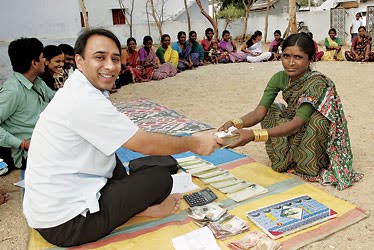
With the sacking of Gurumani, CEO of SKS MicroFinance and the change in guard has become headline for many Business dailies and thw matter is yet to be settled with it going to the court. And many of the clarifications issued on behalf of SKS, but the things are far from the pacification mode and raised the very doubts of orivate sector's participation in the financing, that too at the ground level to the naive and illiterate people. For another jolt as a reverberation of almost the same event, the Andhra Govt vowed to make the days harder for the institutions, due to many fradulant practices and wrongful way of recovery. AP is only considered as the birthplace of MF activities in recent past and then later only the movment has further moved to other parts of Eastern & Southern India, where these agengies almost become moving force for the small and marginal farmers and rural artisans. MFIs might have transformed many a lives but the apprehensions can't be denied on any account, as there is mushrooming of the MFI all throughout, without any Govt watchdog and, exclusive legislation for nailing down the guilty, in case of defaults and fradulent reports. Earlier NGOs did the same and now the practice has been extended to the MFIs but this case may prove to be another stint of mass-suicides, on par with Vidarbha and many other drier tracts of the country.